
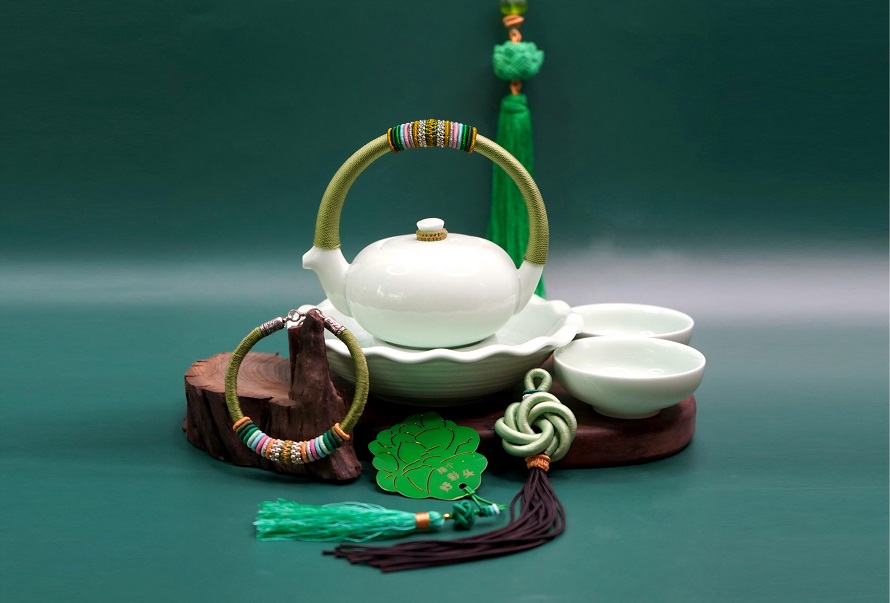
With its exquisite craftsmanship and rich cultures, the Fuzhou Thread-Knotting from Fuling has been selected into the “Chongqing Gifts” as Foreign Affairs Gifts for three consecutive years, becoming a “silent cultural messenger” between China and the world. Originating from the prehistoric practice of “recording events by tying knots”, this intangible cultural heritage (ICH) item has been passed down through generations.
Together with their team, the inheritors Zhang Chenjing and Li Lei have upheld their original aspiration and embraced innovation, helping this ancient craft advance from local lanes of Fuling, Chongqing to the world stage, weaving a beautiful tapestry of cross-cultural communication through every silken thread.
Ingenious Craftsmanship: The Cross-Cultural Innovation in ICH
The history of Fuzhou Thread-Knotting can be traced back to the prehistoric “recording events by tying knots.” Evolving from a practical fastening tool, it gradually transformed into a folk art combining decorative appeal with auspicious symbolism. This skill is an integral part of Bayu folk cultures in Fuling, which also includes the Bayu stilt-house binding techniques, the bamboo weaving for “Baxiangqing” wine jars, and Tujia brocade.
Rooted in people’s daily life, Fuzhou Thread-Knotting records the evolution of regional cultures. The securing knots used by boat-trackers, the load-bearing knots used by street porters who are called “Bang bang jun” by local people, and the auspicious knots used by people in daily life have all become vivid source material for the craft.
Materials are meticulously selected to match the character of each piece. Silk threads, jade cords, and hemp ropes are good material as they can withstand the test of time and they are eco-friendly as well. From an initial sketch to the final piece, more than ten steps are needed. “Sincerity is embedded in the slow work,” Li Lei explains. Even a fairly simple piece requires an artisan to weave, stitch by stitch, knot by knot, for several days or even weeks.
Today, Fuzhou Thread-Knotting incorporates cultural symbols such as the Baiheliang stone fish motif symbolizing “abundance year after year”, the Taiji and Bagua diagrams representing “endless vitality”, and the sight of pickled mustard greens drying on ropes, making each piece a carrier of Bayu Culture’s ancient charm. “The meaning behind every knot is time-honored. What we do is to let this ancient wisdom convey cultural warmth,” says Li Lei.
With flying fingers, old techniques of looping, picking, pulling, threading, winding, tying, braiding, weaving, and knotting are working naturally. While inheritors like Li Lei follow the technical lineage passed down by their ancestors, they are also quietly breaking the traditional “three-strand braid” mold. They incorporate graceful European-style diagonal curl knots and the substantial techniques of Tibetan Buddhist Vajra knots, allowing different cultures to intertwine within the threads, creating a more unique texture, and weaving a characteristic industrial chain with an annual output value exceeding RMB60 million.
Thread-Knotting as bridge: Fostering Sino-Foreign Cultural Exchange
In recent years, Fuzhou Thread-Knotting has frequently appeared on international stages, becoming a culture card for Chongqing’s foreign exchanges. From the “China Impression · China Gifts” International Culture and Commerce Global Tour (Thailand), to the “Beautiful Workshop Blooming in New York” exhibition of Chinese disabled women’s cultural and creative works, and to the 2025 Osaka World Expo China Pavilion “Chongqing Day” event, it has left its footprints across dozens of countries and regions, winning over a hundred honors, including the “Best Inheritance Award (Weaving Art)” at the China International ICH Festival · Competition & Exhibition, “China Gifts,” and “the First Batch of National Beautiful Workshops”.
Foreign guests show a marked preference for this gift full of Eastern charm and even proactively explore the Bayu cultural stories behind it. An elderly German gentleman was reminded of his late wife by a brooch; he experienced the art of knotting under the guidance of an inheritor and regained his memories amid the interlacing threads. Li Lei notes that Fuzhou Thread-Knotting products are now exported to Asia, Europe, America, and other regions, the custom gifts featuring cultural symbols and modern fashion accessories being highly popular.
To sustain the momentum of cultural exchange, the team continuously explores innovative path extending knot elements to contemporary products such as wristwatch accessories, car pendants, and speaker grilles, integrating ICH craftsmanship into daily life, and broadening the scope of dissemination by inviting foreign guests to experience knotting, launching inheritor training programs, and expanding cross-border e-commerce channels.
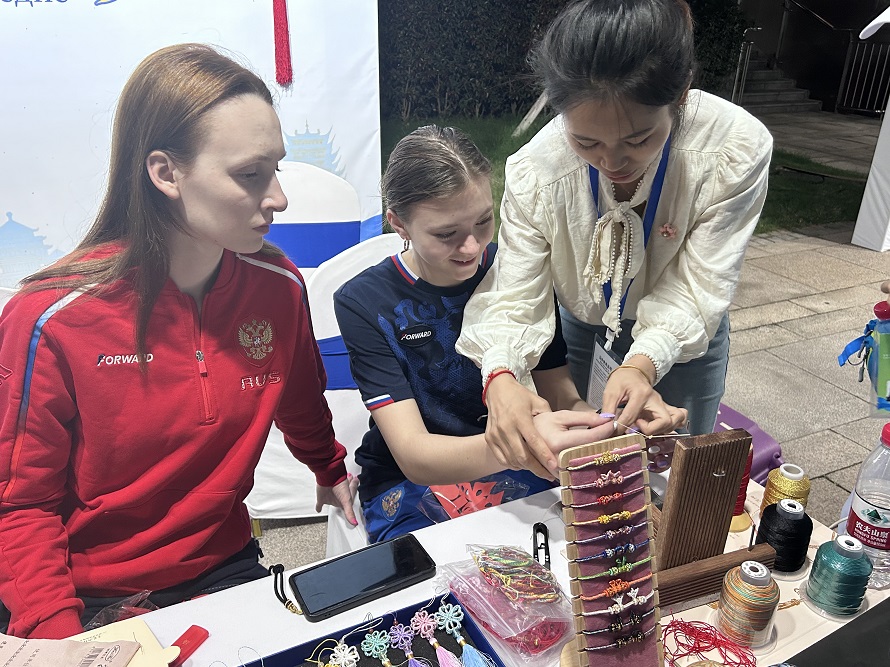
“The ICH preservation is not only about passing on skills but also about heart-to-heart communication,” Li Lei emphasizes. “We want every thread to become a friendship bond connecting China and the world, making the world feel Chongqing’s cultural charm and innovative spirit through Fuzhou Thread-Knotting.”
With craftsmanship as its skeleton and cultures as its soul, Fuzhou Thread-Knotting builds a bridge for cultural exchange between China and the world, telling to the world the stories of Eastern wisdom and its inheriting in China’s intangible cultural heritages.
(This column is a Sino-foreign cultural exchange project jointly operated by The World & Chongqing and the College of International Studies, Southwest University.)



重庆与世界杂志社 Copyright 2000-2023 Cqworld.cn All Rights Reserved. 渝ICP备:05006161/渝公网安备50010302504769号
国内发行:重庆市报刊发行局\杂志社自发 | 国外发行:中国国际图书贸易总公司
地址:重庆市渝中区学田湾正街1号广场大厦11F,举报电话:023-68898926,违法和不良信息举报中心热线:12377

微信公众号